Green Living Magazine · page 39
Golf's Environmental & Economic Impact
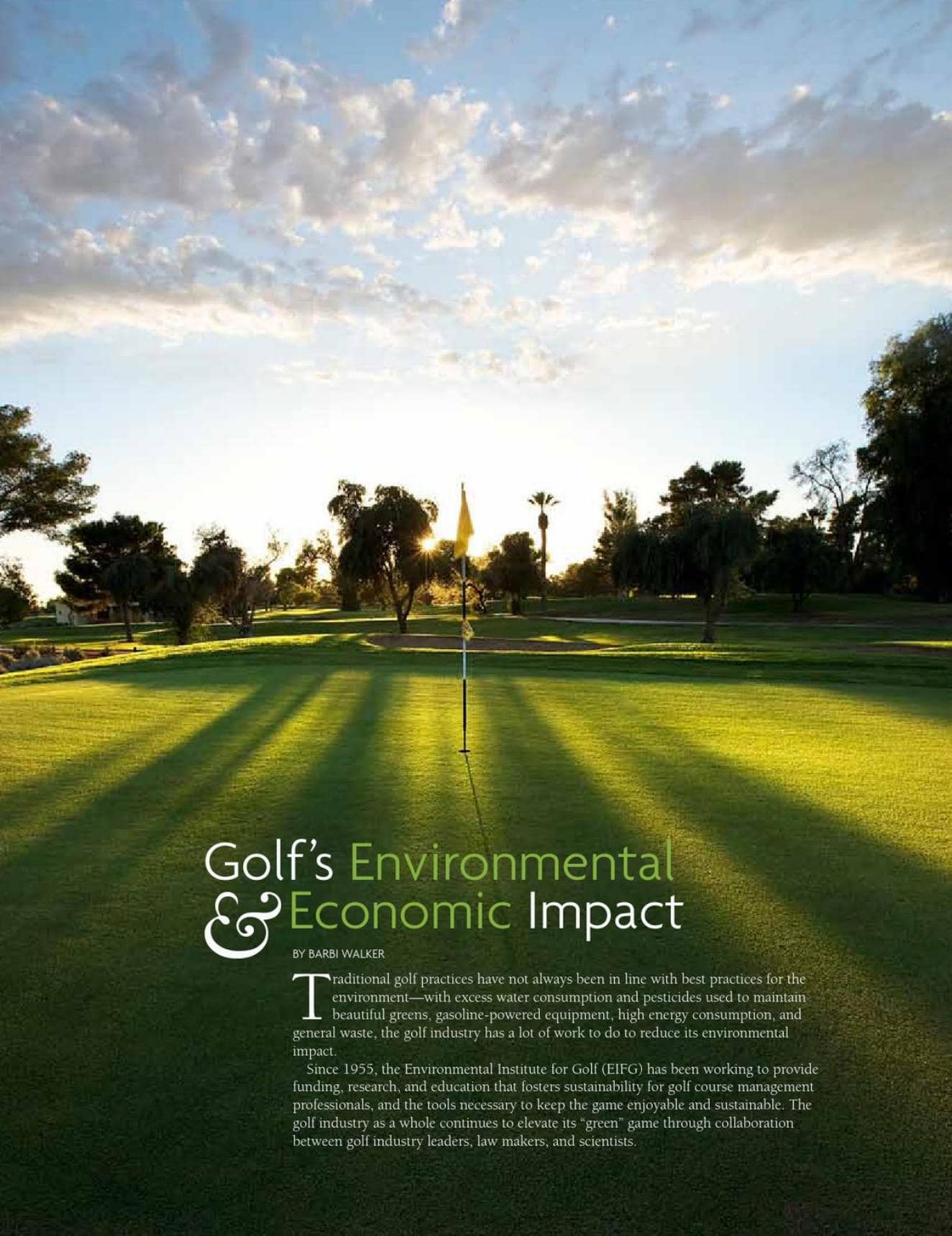
X greenliving January 2013 Comment on this arti cle at Traditional golf practices have not always been in line with best practices for the environment—with excess water consumption and pesticides used to maintain beautiful greens, gasoline-powered equipment, high energy consumption, and general waste, the golf industry has a lot of work to do to reduce its environmental impact. Since the Environmental Institute for Golf (EIFG) has been working to provide funding, research, and education that fosters sustainability for golf course management professionals, and the tools necessary to keep the game enjoyable and sustainable. The golf industry as a whole continues to elevate its “green” game through collaboration between golf industry leaders, law makers, and scientists. & Economic Impact Golf’s Environmental 38 greenliving January 2013 Comment on this article at Feature X greenliving January 2013 COMMUNITIES AND CHARITIES BENEFIT FROM GOLF “Golf courses account for more than two million acres of green space across the U.
S. ,” says Steve Mona, the CEO of the World Golf Foundation, administrator of GOLF “Arizona’s golf economy is a large contributor to the game’s environmental benefi ts with nearly 350 golf facilities, 75 percent of them available to the public.” In a collaboration of leading U. S.
golf organizations formed GOLF and published its fi rst annual report showing the fi nancial impact golf has on the U. S. economy. Golf is a $60 billion industry and contributes heavily to the economy, both locally and nationally.
In Arizona’s golf industry provided $3. 4 billion in revenues and employed nearly people, according to a recent study by Dr. Troy G. Schmitz, Associate Professor at Morrison School of Agribusiness and Resource Management.
GOLF is made up of many leading golf organizations, including the PGA Tour, the American Society of Golf Course Architects, the Professional Golfers Association of America and many others, joined together to promote the economic contributions of golf, both through human and environmental contributions to society. Through this unique collaboration of associations, manufacturers, course owners, and the media, GOLF found that the sport provides much-needed green spaces, competition, and outdoor recreation opportunities. By bringing in thousands of visitors to the state specifi cally for a golf-related activity, golf directly contributes to the vibrancy of our state. The golf industry in Arizona alone adds thousands of jobs.
GOLF supports the continued development of eco-friendly solutions and scientifi c research to promote sustainability on the course and off. In GOLF and SRI International, a non-profi t, independent research company, published a report which became a template to golf facilities the tools and technology to signifi cantly improve energy conservation, lower costs, and effi ciently advance regulatory compliance. Golf isn’t just a game, it’s a major contributor to the economy, and it is now an important player in the fi eld of sustainability. Sustainability is a signifi cant challenge for golf, says Jonathan Smith of the Golf Environment Organization in Golf’s Vision report, but he adds that the challenge is also a great opportunity.
Smith says good courses embrace their natural assets, considering the climate, landscape, and location, rather than trying to change them. Without knowing what improvements need to be done, facilities can’t make improvements. Understanding how they use water and energy gives facilities a baseline on identifying where to modify. Once facilities have the data, developing a written plan is crucial.
The fi nal challenge to modifying golf facilities’ practices for sustainability is making sure owners, managers, staff, and golfers are aware of and practicing the new standards. Things golf facilities can do to improve energy management include conducting energy audits, developing and implementing a written sustainability plan, as well as continuing research to improve and maintain energy use both on the course and in the clubhouse. From solar use to watering off-peak, these measures help the environment and reduce costs. According to the U.
S. Environmental Protection Agency (EPA), its Wetlands Division began working with the golf industry in 1995 to fi nd common ground between the environmental community and the golf industry to promote environmental responsibility. The initiative consists of multiple organizations, including the American Farmland Trust, Golf Course Superintendents Association of America, the National Coalition Against the Misuse of Pesticides, the National Wildlife Federation, the United States Golf Association, and Golf Digest, a leading industry publication. These organizations created a set of Environmental Principles for Golf Courses in the U.
S. that is available to the public and is endorsed by the EPA and over 20 organizations. GOLF endorses the “Statement on Sustainability” by the International Golf Federation (IGF), which employs environmental best practices and oversees golf as an Olympic sport. The focus of the Statement of Sustainability is to support and enhance environmentally responsible and economically viable golf courses, better protecting wildlife and plant species, and more effi ciently managing nature’s resources.
“The IGF statement is a major step in unifying essential principles of golf-course sustainability on a worldwide scale,” says Mona. By focusing on sustainable course design, construction, and management local communities can protect wildlife, the habitat, effi ciently use natural resources, and provide green spaces while supporting ongoing eco-friendly scientifi c research. Additionally, water and energy savings can be realized, as well as improvement in water quality, when developers and course managers employ environmental practices. Safer pesticide and herbicide approaches are underway to ensure that groundwater pollution is also reduced.
EIFG believes golf courses are a valuable asset within communities, providing green spaces to be used and enjoyed, and funding to make a positive difference at golf facilities through research, education, and environmental programs. These changes have huge impacts on the U. S. economy, and according to GOLF golf’s total impact on the U.
S. economy was about $190 billion in GOLF GIVES BACK Despite an economic downturn in charities across the country continued to benefi t from golf. In $3. 9 billion was raised for charities, according to a study released by the National Golf Foundation.
A vibrant and healthy community is important for establishing a vibrant and healthy environment. “Regardless of the economic climate, golf is a key driver of charitable giving in the U. S. ,” Mona said in a statement for GOLF according to the World Golf Foundation.
“As a major focus of the golf industry, working with organizers of philanthropic events helps improve millions of lives.” GREEN TRAVELERS VALUE GREEN COURSES In out-of-state visitors contributed more than $1. 9 billion in golf-related tourism and activities to the state of Arizona. Travelers tend to be more savvy and knowledgeable about sustainability— according to research, 4 out of 10 U.
S. travelers consider the environment when planning trips. Travelers look for destinations that offer green hotels, restaurants, and attractions, according to the Arizona Offi ce of Tourism. Golf is a large part of the attraction for visitors to Arizona.
Water usage and irrigation are important factors for Arizona and governmental policies, as well as the use of pesticides. Although many debates about the environmental impact of golf courses abound, the fi nancial benefi t of golf through tourism can’t be dismissed. Through GOLF industry leaders, golfers, and the community can work together to preserve the game of golf, while taking care of the environment as well as the communities golf serves. It’s the responsibility of golf’s industry leaders to care for the environment and continue the sport’s vitality for future generations, says Mona.
Text recovered from the printed pages; the scan below is the edition of record.
The printed page